Eddie Van Halen
Bio
Eddie Van Halen was a Dutch-born American musician, guitarist, songwriter, keyboardist, record producer, and inventor best known as the co-founder and lead guitarist of Van Halen. Born Edward Lodewijk Van Halen in Amsterdam, Netherlands, he moved with his family to Southern California as a child. Alongside his older brother Alex Van Halen, Eddie grew up studying music and eventually shifted from piano and drums to guitar, where he developed one of the most recognizable and influential styles in rock history.
Eddie and Alex Van Halen began playing music together as teenagers in Pasadena, California. After performing in early groups, they formed the band that became Van Halen with vocalist David Lee Roth and bassist Michael Anthony. The group built a strong reputation on the Southern California club circuit before signing a record deal and releasing their self-titled debut album in 1978.
Van Halen’s debut album immediately changed the sound of hard rock. Eddie’s instrumental showcase “Eruption” stunned listeners with its speed, precision, tone, and two-handed tapping technique. His playing combined blues rock, classical influence, aggressive rhythm work, and explosive soloing in a way that inspired a generation of guitarists. Almost overnight, Eddie became one of the most talked-about guitar players in the world.
Throughout the late 1970s and early 1980s, Van Halen became one of rock’s biggest bands. Albums such as Van Halen, Van Halen II, Women and Children First, Fair Warning, Diver Down, and 1984 featured Eddie’s powerful guitar riffs, inventive solos, and energetic songwriting. Songs such as “Runnin’ with the Devil,” “Ain’t Talkin’ ’bout Love,” “Dance the Night Away,” “Unchained,” “Panama,” “Hot for Teacher,” and “Jump” became classic rock staples.
Eddie was also a major sonic innovator. He built and modified guitars, amplifiers, and effects to create his signature “brown sound,” a warm but aggressive tone that became one of the most copied sounds in rock guitar. His famous red, black, and white striped “Frankenstrat” guitar became one of the most iconic instruments in music history. Eddie’s technical ideas and gear experiments influenced guitar manufacturing, amplifier design, pickup development, and modern rock performance.
In 1984, Van Halen reached a new commercial peak with the album 1984. Eddie’s keyboard riff on “Jump” helped the song become the band’s first and only number-one single on the Billboard Hot 100. Although some fans initially associated him mainly with guitar heroics, “Jump” showed his ability to write memorable keyboard-driven rock songs while still delivering his trademark guitar work.
After David Lee Roth left Van Halen in 1985, Sammy Hagar joined as lead vocalist. The Hagar era brought continued success with albums such as 5150, OU812, For Unlawful Carnal Knowledge, and Balance. During this period, Van Halen scored major hits including “Why Can’t This Be Love,” “Dreams,” “Love Walks In,” “When It’s Love,” “Right Now,” and “Top of the World.” Eddie’s playing continued to evolve, blending guitar, keyboards, melodic songwriting, and studio experimentation.
Outside Van Halen, Eddie contributed one of rock’s most famous guest solos to Michael Jackson’s 1982 hit “Beat It.” His fiery guitar break helped bridge hard rock and pop music and introduced his playing to an even wider audience. He also collaborated with other artists, developed signature music equipment, and became a major influence on rock, metal, pop, and instrumental guitar players.
Van Halen was inducted into the Rock and Roll Hall of Fame in 2007, recognizing the band’s enormous influence on rock music. Eddie Van Halen’s impact extended far beyond record sales. His approach to tone, technique, stage presence, guitar design, and musical experimentation permanently changed what many players believed was possible on the electric guitar.
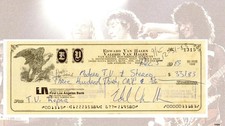
Eddie Van Halen died on October 6, 2020, after a long battle with cancer. His death brought tributes from musicians and fans around the world. As a memorabilia figure, Eddie remains one of the most collectible guitarists in rock history. Signed guitars, Frankenstrat-style replicas, Van Halen autographs, concert posters, tour programs, vintage records, stage-used gear, photographs, and authenticated signatures are highly sought after by collectors. His legacy as a guitarist, inventor, songwriter, and rock icon continues to shape generations of musicians.
Accomplishments
(1978) Eruption
Clocking in at just one minute and forty-two seconds, this instrumental track is the most influential guitar solo in the history of rock music. Played on his home-built "Frankenstrat," Eddie introduced the world to two-handed tapping, lightning-fast cascades, and aggressive dive-bombs that completely melted the minds of guitarists everywhere. It divided rock history into two distinct eras: everything that came before "Eruption," and everything that came after.
(1982) Beat It
As a guest feature, this is arguably Eddie’s most culturally significant contribution to music history. When Quincy Jones called him to add a rock edge to Michael Jackson's new track, Eddie did it for free as a favor. He famously walked into the studio, rearranged the backing track of the song without permission, and knocked out a fiery, spontaneous, boundaries-shattering solo that helped Thriller bridge the gap between R&B and rock, propelling it to become the best-selling album of all time.
(1984) Jump
While purists wanted him to just shred, Eddie was a classically trained pianist who wanted to expand Van Halen's sound. Against the initial wishes of his bandmates and producer, he used an Oberheim OB-Xa synthesizer to write the driving, unforgettable opening hook for "Jump." The gamble paid off massively: it became Van Halen's only number-one hit on the Billboard Hot 100, proving that Eddie's pop sensibilities and songwriting chops were just as powerful as his guitar solos.