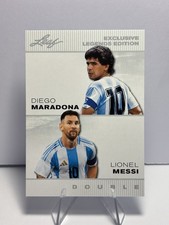
Diego Maradona
Bio
Diego Armando Maradona Franco was born in Lanús, Buenos Aires, Argentina, the fifth of eight children raised in a poor barrio called Villa Fiorito. He received his first soccer ball at age three and was dribbling oranges before he could walk. At age eight, he was spotted by a scout for Argentinos Juniors and became a national sensation when a video of him performing halftime juggling tricks went viral across Argentina. At 15, he made his professional debut for Argentinos Juniors, and at 16, he was called up to the Argentine national team — the youngest player ever selected. In 1981, he transferred to Boca Juniors, winning his first league title. The world took notice at the 1982 World Cup in Spain, though Argentina was eliminated in the second round. In 1984, a world-record $7.6 million transfer sent Maradona to Napoli in Italy's Serie A — a team that had never won a league title. Over seven seasons, Maradona single-handedly transformed Napoli into champions, leading them to two Serie A titles (1986-87, 1989-90), a Coppa Italia (1987), a UEFA Cup (1989), and an Italian Supercup (1990). For the people of Naples, a struggling southern city often looked down upon by wealthier northern Italian clubs, Maradona became a god. But it was the 1986 FIFA World Cup in Mexico that cemented Maradona's immortality. In the quarterfinal against England — just four years after the Falklands War — Maradona scored two of the most famous goals in football history. The first, the "Hand of God," saw him punch the ball past England goalkeeper Peter Shilton, a goal he later claimed was scored "a little with the head of Maradona and a little with the hand of God." The second, the "Goal of the Century," saw him pick up the ball in his own half, dribble past five English defenders (including a last-ditch sliding tackle from Shilton), and slot it into an empty net. Argentina won 2-1, then defeated Belgium in the semifinal and West Germany 3-2 in the final, with Maradona lifting the World Cup trophy as captain. He finished the tournament with five goals and five assists, winning the Golden Ball as the tournament's best player. Maradona's later years were plagued by cocaine addiction, health struggles, and controversy. He was banned from the 1994 World Cup after testing positive for ephedrine, ending his international career in disgrace. After retirement, he bounced between coaching jobs, famously leading Argentina to the 2010 World Cup quarterfinals before being eliminated by Germany 4-0. He also coached Mexican club Dorados de Sinaloa and Argentine club Gimnasia de La Plata. Off the pitch, Maradona was a larger-than-life figure: a socialist icon who befriended Fidel Castro and Hugo Chávez, a fiercely emotional showman who cried and cursed in equal measure, and a man who once told reporters, "I made mistakes and paid for them, but the ball never gets dirty." He died of a heart attack on November 25, 2020, at age 60, just weeks after undergoing brain surgery. Three days of national mourning were declared in Argentina, and his funeral at the Casa Rosada (the presidential palace) drew over a million mourners, leading to riots when lines stretched for miles. Known for his magical left foot, low center of gravity, ability to dribble through entire defenses as if they were training cones, and a fiery personality that made him beloved and controversial in equal measure, Diego Maradona remains one of the most gifted and tragic figures in sports history — a man who, as he once said, "played for the shirt, for the people, for the glory."
Accomplishments
2000 - Sports: FIFA Player of the Century (2000) – Shared with Pelé
Genre: Individual Recognition / Legacy Award
Co-stars: Fellow nominee: Pelé (Brazil); other legends: Johan Cruyff, Franz Beckenbauer, Alfredo Di Stéfano, Zinedine Zidane, Eusébio, Bobby Charlton
Brief Description: In December 2000, FIFA named Maradona and Pelé co-winners of the "FIFA Player of the Century" award. Maradona won the internet fan vote (53.6%) while Pelé won the popular vote (72.8%) and FIFA family vote, so a compromise was reached naming both players co-recipients. The award recognized Maradona as the most naturally gifted and purely entertaining player of his generation — a flawed genius whose highs reached heights football may never see again.
1986 FIFA World Cup Champion & Golden Ball Winner
Genre: International Championship / One-Man Dynasty
Co-stars: Argentina teammates: Jorge Burruchaga, Claudio Caniggia, Jorge Valdano, Oscar Ruggeri, Sergio Batista, Néstor Clausen; opponents in quarterfinal: England; opponent in final: West Germany
Brief Description: In the 1986 World Cup in Mexico, Maradona delivered arguably the greatest single-player performance in tournament history. He scored five goals and provided five assists, single-handedly carrying Argentina to the title. In the quarterfinal against England — just four years after the Falklands War — he scored two iconic goals: the infamous "Hand of God" (a punched ball ruled a goal) and the "Goal of the Century" (dribbling past five English defenders from midfield). He won the Golden Ball as tournament MVP and lifted the World Cup trophy as captain.
1984 - Sports: Transforming Napoli from Nobody to Italian Champions (Two Serie A Titles)
Genre: Club Championship / Underdog Revolution
Co-stars: Napoli teammates: Careca, Ciro Ferrara, Salvatore Bagni, Alemao, Bruno Giordano, Giancarlo Corradini; rival clubs: Juventus, AC Milan, Inter Milan
Brief Description: When Maradona arrived at Napoli in 1984 for a world-record $7.6 million, the club had never won a Serie A title. Over seven seasons, he led the southern Italian underdogs to two Serie A championships (1986-87, 1989-90), a Coppa Italia (1987), a UEFA Cup (1989), and an Italian Supercup (1990). For Naples — a poor, often-mocked city in Italy's industrial north's shadow — Maradona became a deity. His #10 jersey remains retired by the club, and the Stadio San Paolo was renamed Stadio Diego Armando Maradona in 2020 following his death.
News
Fans pick their own World Cup legends after The Independent’s top 50 sparks debate
At the very top, the consensus around the podium was mixed but passionate. Several readers backed Pele as undisputed No 1, with one insisting: “Pele without a doubt. Yes, Maradona at 2.”